Networking
Enterprise and service-provider networking — campus to ISP/MPLS, legacy platforms through current-generation design.
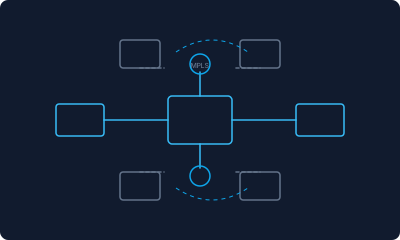
Networking is where most outages become visible and where design mistakes linger for years. We have designed, migrated, and operated networks from branch switching through blade chassis fabrics, software-defined segments, and ISP-level MPLS services — across vendor generations that many teams no longer touch.
Vendor & platform experience
- Cisco — from established IOS and Catalyst deployments through current Nexus, ASR, and SD-Access/SD-WAN environments; migrations without unnecessary rip-and-replace
- HPE networking — ProCurve/Aruba campus and datacentre switching, fabric and controller-based designs
- Unify — enterprise LAN/voice-adjacent network integration where Unify platforms form part of the estate
- Blade & chassis networking — interconnect modules, virtual connect fabrics, and intra-chassis traffic engineering
- SDN & software-defined segments — controller-based policy, overlay networks, and automation hooks where they reduce operational load
Typical work
- Campus and datacentre LAN design — VLANs, STP/RSTP, LACP, stacking, redundancy
- Routing design and troubleshooting — OSPF, BGP, static and policy-based routing, route aggregation
- WAN and branch connectivity — MPLS L2/L3 VPNs, VRFs, QoS markings end-to-end
- ISP- and carrier-facing work — last-mile handoff, CE/PE routing, circuit diversity, failover
- Firewall and perimeter integration — without turning the network into an unmaintainable rule maze
- Wireless planning and controller integration as part of the wired design
- Network documentation, baselines, and lifecycle management through hardware refresh cycles
- Monitoring integration — interface, BGP peer, and path checks wired into Icinga and on-call flows
Scale & context
We have worked in environments where a misconfigured trunk takes down a floor, and in environments where an MPLS VPN misroute affects national branches. The discipline is the same: know your failure modes, document your intent, and test failover before production insists on it.
Pragmatic standard
Right-sized design for the traffic you actually carry. Legacy gear operated safely until replacement is justified. Changes with rollback plans — not cutovers that depend on luck.
Other services
Explore the rest of our practice areas.
Backend & integration
Full-stack development and service integration to connect components into dependable production systems.
View service
Infrastructure & datacentre design
Datacentre and compute architecture — designed for high availability and long operational life.
View service
Databases & data platforms
Database deployment, management, and optimisation for workloads that must stay fast and recoverable.
View service
Security & auditing
Security engineering, infrastructure auditing, and resilience planning aligned with operational reality.
View service
DevOps, SRE & monitoring
Automation, observability, SRE practices, alerting integration, and agentic flows for service management.
View service
Storage & backup
Storage architecture, backup strategy, and recovery procedures tested against real restore scenarios.
View service
Advisory & training
Architecture review and hands-on knowledge transfer for backend, infrastructure, and operations teams.
View serviceDiscuss this area
Tell us what you are running and what needs to change. We will respond with a direct assessment.